---
title: "Implementation Playbook: Segmenting Google Shopping by Product Group Relevance Step-by-Step (Rules, Labels, and Scripts)"
description: "Implementation playbook for segmenting Google Shopping by product group relevance: a 30-minute audit, a 4-phase rollout, a label schema and a 14-day pilot."
canonical: "https://www.productmetrics.io/blog/segment-google-shopping-by-product-group"
pageType: article
language: en
publisher: "Product Metrics"
author: "Berend Vrakking"
datePublished: 2026-10-31
dateModified: 2026-11-09
image: "https://www.productmetrics.io/og/blog/segment-google-shopping-by-product-group.png"
---
> Content index: https://www.productmetrics.io/llms.txt
# Implementation Playbook: Segmenting Google Shopping by Product Group Relevance Step-by-Step (Rules, Labels, and Scripts)
## Key takeaways
- A relevance-based product label schema that works for both Standard Shopping and Performance Max
- A phased campaign structure using those labels (no big‑bang restructures)
- Lightweight rules and script logic to keep segmentation fresh
If your Shopping or Performance Max spend is concentrated in a few messy product groups, you’re not short on budget—you’re short on relevance.
This playbook walks through a low‑risk, step‑by‑step rollout to segment Google Shopping by **product group relevance**, then operationalize it with **rules, labels, and scripts**. The goal: move from “[evaluating tools](https://www.productmetrics.io/blog/google-shopping-segmentation-platforms)” to a controlled **pilot of Product Metrics** without blowing up your existing performance.
You’ll ship:
- A relevance-based product label schema that works for both Standard Shopping and Performance Max
- A phased campaign structure using those labels (no big‑bang restructures)
- Lightweight rules and script logic to keep segmentation fresh
## 1. What Product Group Relevance Really Means
[Google Shopping ads](https://www.productmetrics.io/blog/google-shopping-ads-beginners-guide) don’t use keywords. They use your **Merchant Center feed** as input, then you decide which products to bid on through product groups (Standard Shopping) or listing groups ([Performance Max](https://www.productmetrics.io/glossary/performance-max)). (Source: [Product Metrics – Google Shopping ads](https://www.productmetrics.io/google-shopping-ads))
In practice, **product group relevance** is how well each group lines up with:
1. **Query intent** – Are the search terms hitting these products a fit, or is this group hoovering up low‑intent noise?
2. **Product economics** – Margin, price point, and break-even ROAS/[POAS](https://www.productmetrics.io/glossary/poas "POAS (profit on ad spend) means contribution profit before advertising divided by ad spend: the profit each euro of ads leaves.").
3. **Ad performance** – Click volume, conversion rate, [ROAS](https://www.productmetrics.io/glossary/roas "Return on ad spend (ROAS) is the revenue your ads generate for every euro you spend on them.")/POAS, and volatility over time.
A “relevant” product group is one where:
- Products behave similarly (performance & margin)
- You’d willingly give them a shared target (ROAS/CPA/POAS) and budget
- Changing that target for the group is more helpful than harmful
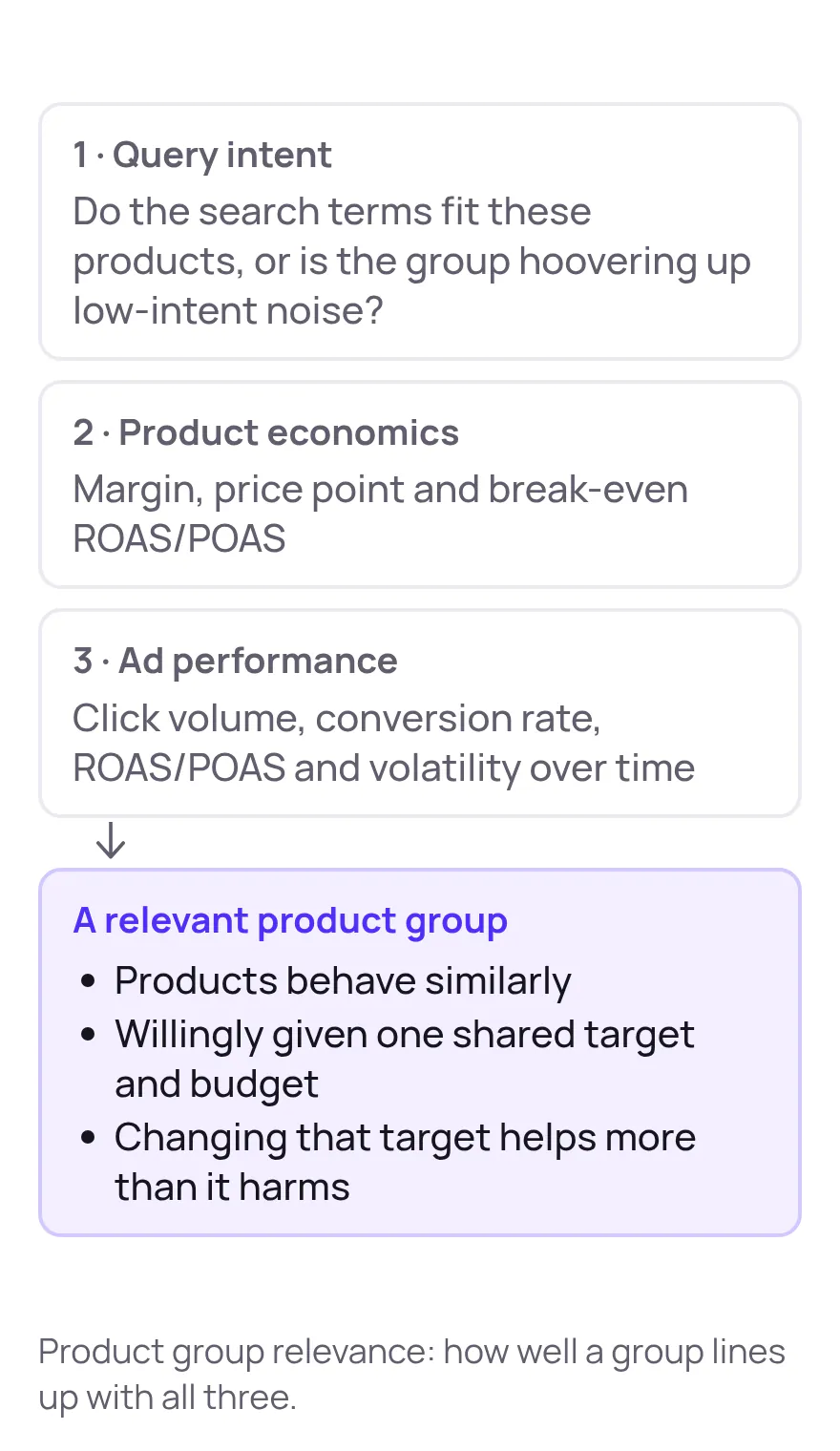
_A product group is relevant when it passes all three checks: query intent, product economics and ad performance._
Everything in this playbook is about getting to those kinds of groups—and keeping them there as data changes.
## 2. Preflight - 30 Minute Audit of Your Current Shopping PMax Setup
Before changing anything, take a snapshot of how Google currently sees your products.
### 2.1 Pull the Current Product Group View
In Google Ads:
1. Open a representative Shopping or Performance Max campaign.
2. Go to **Product groups** (Standard Shopping) or **Listing groups** (Performance Max). (Source: [Google Ads Help – Monitor and optimize your Shopping campaigns](https://support.google.com/google-ads/answer/3455573))
3. [Download performance for the last 30–90 days](https://www.productmetrics.io/blog/historical-roas-analysis-google-shopping) with at least: impressions, clicks, cost, conversions, revenue, ROAS/conv. value.
Flag these red‑flags:
- One **All products** group with a single bid or [tROAS target](https://www.productmetrics.io/glossary/target-roas)
- Product groups split only by **Category** or **Brand**, but each group includes hundreds or thousands of SKUs
- The top 10% of SKUs by spend are scattered across many groups with different goals
### 2.2 Capture the Financial Baseline
For your pilot scope (e.g., one country + one major category):
- Ad spend
- Revenue / orders
- ROAS and, ideally, **[break-even ROAS per product](https://www.productmetrics.io/break-even-roas-calculator)** or at least per category/margin band (Source: [Product Metrics – Google Shopping ads](https://www.productmetrics.io/google-shopping-ads))
You’ll use this to:
- Size the impact of the pilot
- Prove the new structure is at least neutral before you scale it
## 3. The 4 Phase Rollout Roadmap (Low Risk Change Management)
We’ll use four phases:
1. **Observe** – Add labels, no structural change
2. **Pilot** – New campaigns for your highest‑relevance products
3. **Expand** – Roll segmentation across more products
4. **Automate** – Rules + scripts + Product Metrics keeping labels and structure aligned
This is designed so you can **switch off the pilot in minutes** if something goes wrong—your original structure remains intact until you are confident.
### Phase 1 - Observe (Labels Only, No Campaign Changes)
Goal: Get relevance data into your feed via labels, without touching existing bids or budgets.
You have two ways to do this.
#### Option A: Manual Labels (Small Catalogs, Early Stage)
1. Decide on 3–5 performance bands based on your download (e.g., `star`, `cash_cow`, `question_mark`, `dog`, `drainer`).
2. In a spreadsheet, assign each product to a band based on clicks and ROAS/POAS over the last 30–90 days.
3. Add a **custom a_label_0** column in your Merchant Center primary or [supplemental feed](https://www.productmetrics.io/glossary/supplemental-feed) and populate it with those band values. (Source: [Google Merchant Center Help – Custom label 0–4](https://support.google.com/merchants/answer/6324473))
> **Sidenote:** Custom labels 0–4 are dedicated fields in Merchant Center designed specifically to group products for Shopping and Performance Max. They don’t show to shoppers; they’re purely for your segmentation and bidding. (Source: [Product Metrics – Custom labels glossary](https://www.productmetrics.io/glossary/custom-labels))
#### Option B: Product Metrics Labels (Fastest, Scalable)
With Product Metrics:
1. **Connect Google Ads and Merchant Center.**
2. Product Metrics’ ML segments every product into six segments (**Stars, Question Marks, Cash Cows, Dogs, Drainers, Ghosts**) by ad clicks and return ([ROAS or POAS](https://www.productmetrics.io/blog/poas-vs-roas)). (Source: [Product Metrics – Product Segmentation](https://www.productmetrics.io/))
3. Each segment is written to a Merchant Center **custom label** (for example, `custom_label_0 = stars/cash_cows/dogs/...`). (Source: [Product Metrics – Google Shopping ads](https://www.productmetrics.io/google-shopping-ads))
You now have a live, daily‑refreshed relevance label on every product—with no changes yet to your Google Ads structure.
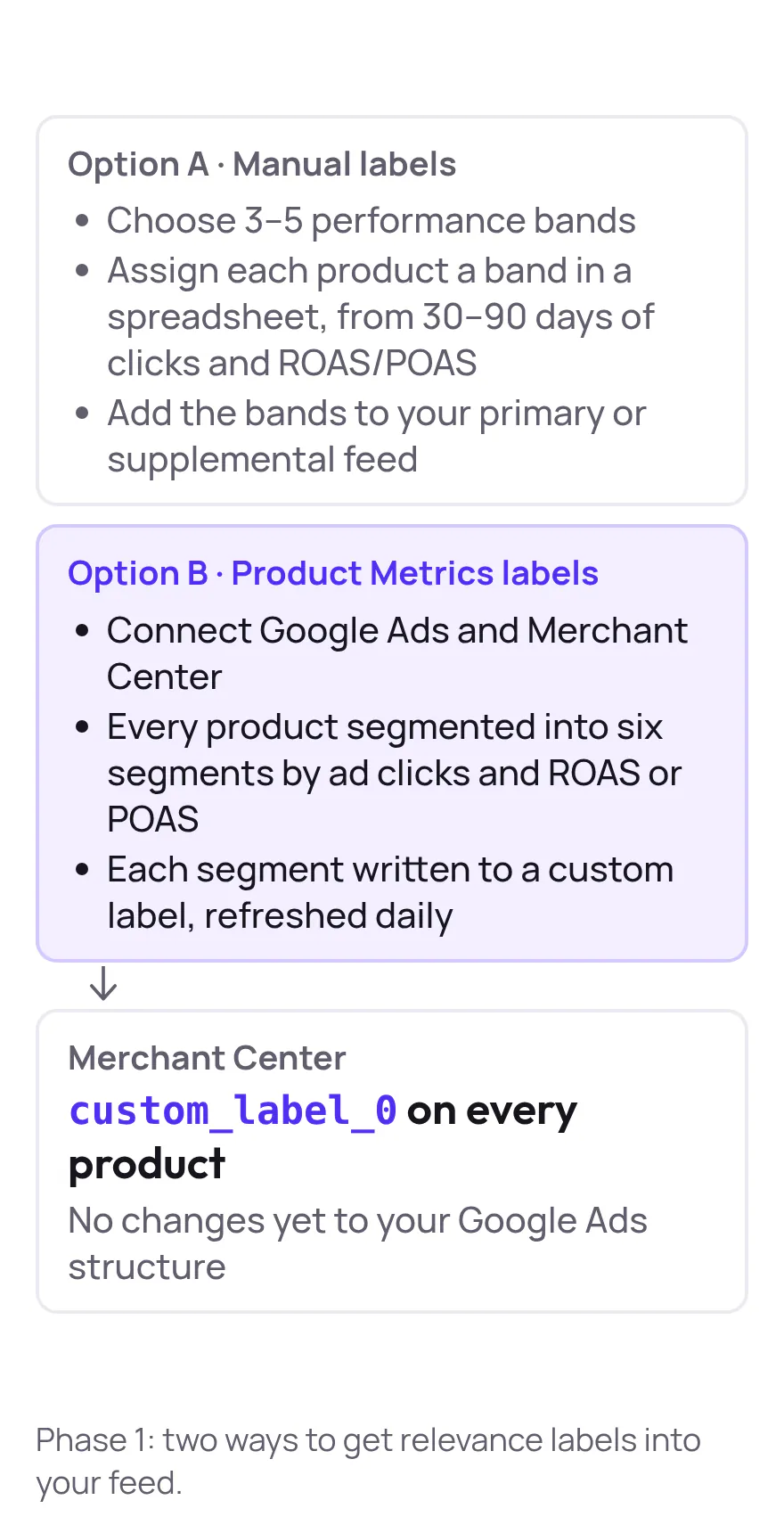
_Both options end in the same place: custom_label_0 on every product, before any campaign changes._
> **Six segments, written to Merchant Center** Product Segmentation gives every product one of six segments from its ad clicks and ROAS or POAS, and writes it to a custom label your Shopping and Performance Max campaigns can filter on. [See how Product Segmentation works](https://www.productmetrics.io/product-segmentation)
Exit criteria for Phase 1
- At least 2–4 weeks of performance data with the new labels populated
- Clear patterns: e.g., Stars consistently above break-even, Drainers consistently below
### Phase 2 - Pilot - New Campaigns for High Relevance Products
Goal: Give your most relevant products their own budget and targets while leaving the old structure in place as a safety net.
#### 3.2.1 Choose a Narrow Pilot Scope
For example:
- Country: United States
- Category: Top revenue category (e.g., Running Shoes)
- Segments: `stars` and `cash_cows` (or equivalent high‑relevance bands)
#### 3.2.2 Build the Pilot Campaigns
For **Standard Shopping**:
1. Create a **new Shopping campaign** with the same settings as your current main campaign (locations, devices, bidding strategy).
2. Use an **inventory filter** or product groups to **include only products where `custom_label_0` is `stars` or `cash_cows`**. (Source: [Google Ads Help – Manage a Shopping campaign with product groups](https://support.google.com/google-ads/answer/6275317))
3. Start with conservative bids / tROAS based on current performance of these products.
4. In the old campaign, **exclude these label values** from product groups so you don’t double-serve.
For **Performance Max**:
1. Create a new PMax campaign for the same scope.
2. In your listing groups, filter to `custom_label_0 in (stars, cash_cows)` for the asset group(s) in scope. Google’s Performance Max listing groups support filtering on feed dimensions like brand and [custom labels](https://www.productmetrics.io/glossary/custom-labels "Custom labels are five attributes in a product feed, custom_label_0 to custom_label_4, that you fill with your own text to group products in campaigns."). (Source: [Google Ads API – Listing groups for Performance Max](https://developers.google.com/google-ads/api/performance-max/listing-groups))
3. In your existing PMax, add an exclusion for those same labels to avoid collisions.
#### 3.2.3 Run Side By Side, Not Rip And Replace
For 2–4 weeks:
- Let the **pilot campaigns** own `stars` and `cash_cows`.
- Let the **legacy campaign** keep everything else.
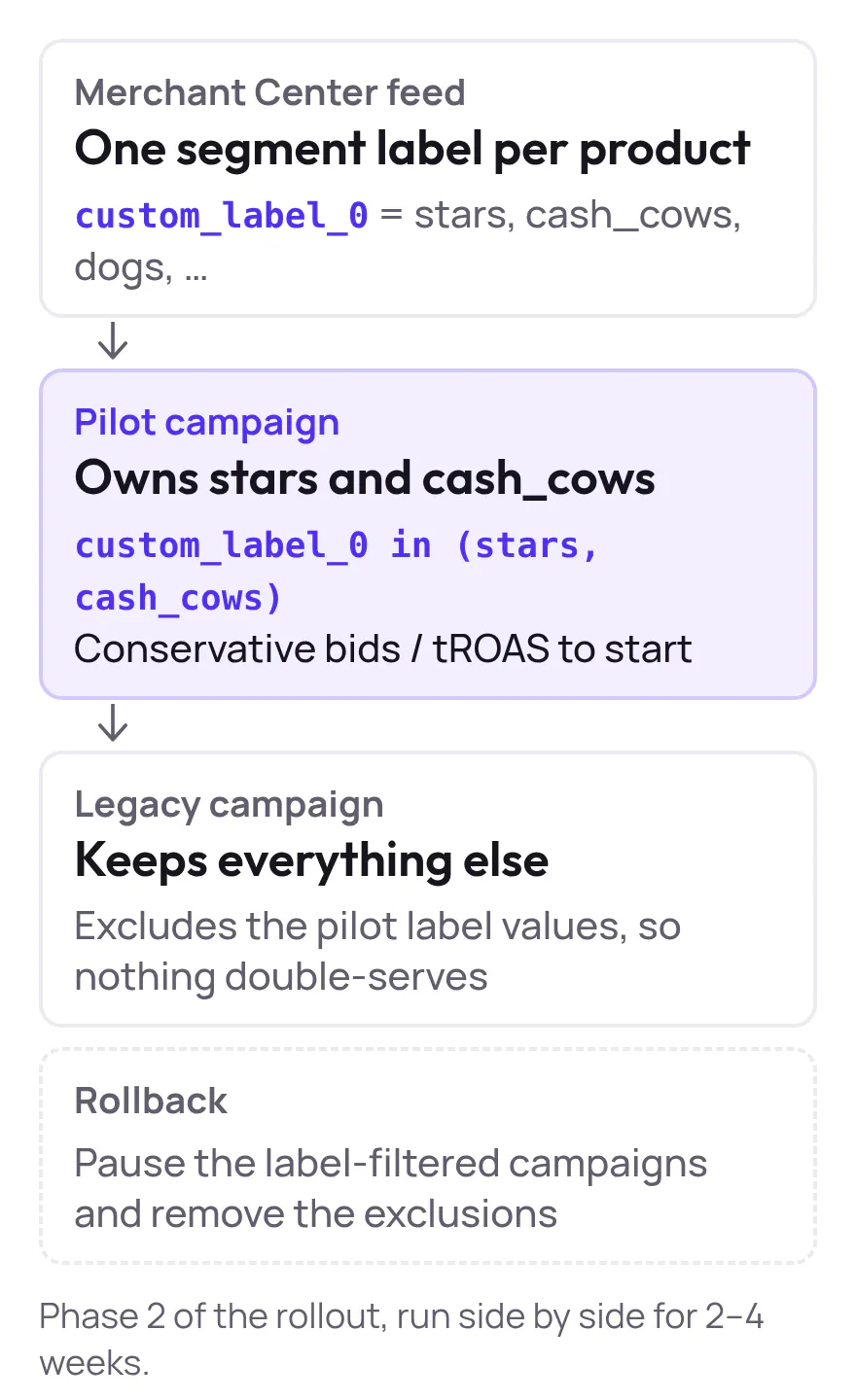
_The pilot owns stars and cash_cows, the legacy campaign keeps everything else, and rollback is pausing the pilot and removing the exclusions._
Compare:
- ROAS/POAS vs. break-even for the pilot labels
- Budget share going to high‑relevance labels vs. the old one‑size‑fits‑all group
If the pilot underperforms, you can roll back rapidly by removing or pausing the label‑filtered campaigns and removing exclusions.
### Phase 3 - Expand - Cover the Rest of Your Catalog
Once the pilot is stable:
1. Add campaigns or asset groups for `question_marks` (medium return, high volume) and, if useful, `dogs` (high volume, low return).
2. Make conscious decisions:
- Do **Drainers** get a tiny budget for testing, or are they paused entirely?
- Do **Ghosts** get a reactivation campaign (SEO, feed fixes, pricing work) before you ever put them into Shopping again?
3. Keep **one low‑priority catch‑all** campaign or asset group to ensure nothing is completely orphaned.
This is where you move from “single average ROAS” to **explicit, label‑based priorities** across your product set, a widely recommended best practice for scaling Shopping and PMax profitably. (Source: [Channable – Google Shopping campaign structure](https://www.channable.com/blog/campaign-structure))
> **Get more revenue out of Google Shopping.** Every product segmented and labelled in Merchant Center, so your top performers get more priority. [Analyse your products for free](https://app.productmetrics.io/) Log in with Google, no credit card.
### Phase 4 - Automate - Rules, Labels, Scripts
Once segmentation is working, you want it to stay current without weekly spreadsheet marathons.
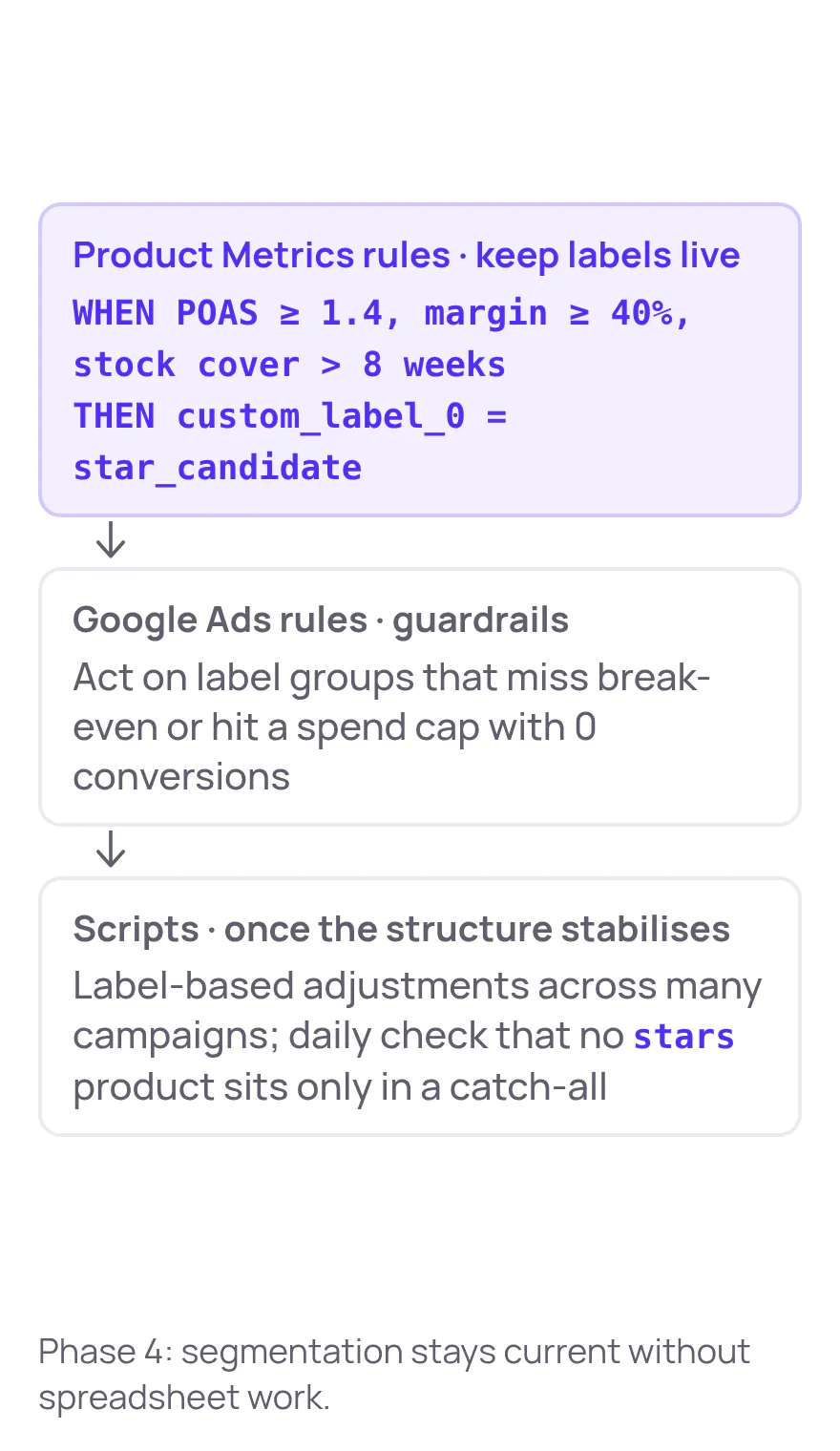
_Rules keep the labels current, Google Ads rules guard the downside and scripts take over once the structure is stable._
#### 4.1 Keep Labels Live with Product Metrics Rules
Product Metrics lets you define **WHEN / THEN rules** over product metrics and business data, then writes the result into Merchant Center labels—for example:
> WHEN POAS ≥ 1.4, margin ≥ 40%, and stock cover > 8 weeks, THEN set `custom_label_0 = star_candidate`.
Those labels then flow directly into your Shopping and PMax campaign structure. (Source: [Product Metrics – Product rules](https://www.productmetrics.io/))
#### 4.2 Use Google Ads Rules for Guardrails
Examples:
- **Rule:** If a product group with label `stars` spends more than $X in 7 days with ROAS < break-even, lower bids by Y%.
- **Rule:** If a `drainers` group hits a spend cap with 0 conversions, pause the group.
You can implement these using Google Ads automated rules at the product group level, keyed off your custom labels and ROAS/conv. value.
#### 4.3 Add Scripts Once the Structure Stabilizes
When you’re happy with the structure, scripts can automate:
- Label-based bid adjustments across many campaigns
- Daily checks that no product with `custom_label_0 = stars` is only in a catch-all group
Pseudo‑logic example (intentionally simplified):
```javascript
// Pseudo-code only – adapt to your environment
for each productGroup in shoppingProductGroups {
var label = productGroup.customLabel0;
if (label == 'stars' && productGroup.roasLast30Days > targetRoasStars) {
increaseBid(productGroup, 0.10); // +10%
}
if (label == 'drainers' && productGroup.spendLast30Days > drainersCap && productGroup.conversionsLast30Days == 0) {
pauseProductGroup(productGroup);
}
}
```
This is where a tool like Product Metrics earns its keep: it focuses on **segmentation and labels**, while you keep full control over where and how those labels drive bidding. (Source: [Product Metrics – Google Shopping ads](https://www.productmetrics.io/google-shopping-ads))
## 4. Designing a Label Schema That Actually Works
A good schema is:
- **Small** – usually 1–2 label fields used for segmentation (e.g., performance band + margin band)
- **Stable** – values don’t flip every day, but they do update as data accumulates
- **Aligned to levers** – if two label values will never get different budgets or targets, they shouldn’t be separate values
### 4.1 Recommended Starting Point
Use **two labels**:
1. `custom_label_0` – **Performance segment** (`stars`, `cash_cows`, `question_marks`, `dogs`, `drainers`, `ghosts`)
2. `custom_label_1` – **Margin band** (`low_margin`, `mid_margin`, `high_margin`)
Custom labels are designed specifically for this type of grouping and are supported as filters and subdivision dimensions in both Shopping and Performance Max. (Source: [Google Merchant Center Help – Custom label 0–4](https://support.google.com/merchants/answer/6324473))
With Product Metrics, the performance segment is maintained for you; you can add margin bands once you connect margin data so segmentation happens on **clicks × return** instead of revenue alone. (Source: [Product Metrics – Google Shopping ads](https://www.productmetrics.io/google-shopping-ads))
### 4.2 How Labels Map to Structure
For a typical account, a clean mapping might look like this:
- **Campaign: Shopping - Stars & Cash Cows (US)**
Filter: `custom_label_0 in (stars, cash_cows)`; higher budget, tROAS close to or slightly above break-even.
- **Campaign: Shopping - Question Marks (US)**
Filter: `custom_label_0 = question_marks`; test budgets, aggressive feed and pricing tests.
- **Campaign: Shopping - Dogs & Drainers (US)**
Filter: `custom_label_0 in (dogs, drainers)`; low bids or tight caps.
- **Catch-all:**
No label filters; low priority and low bids to pick up uncategorized or new products.
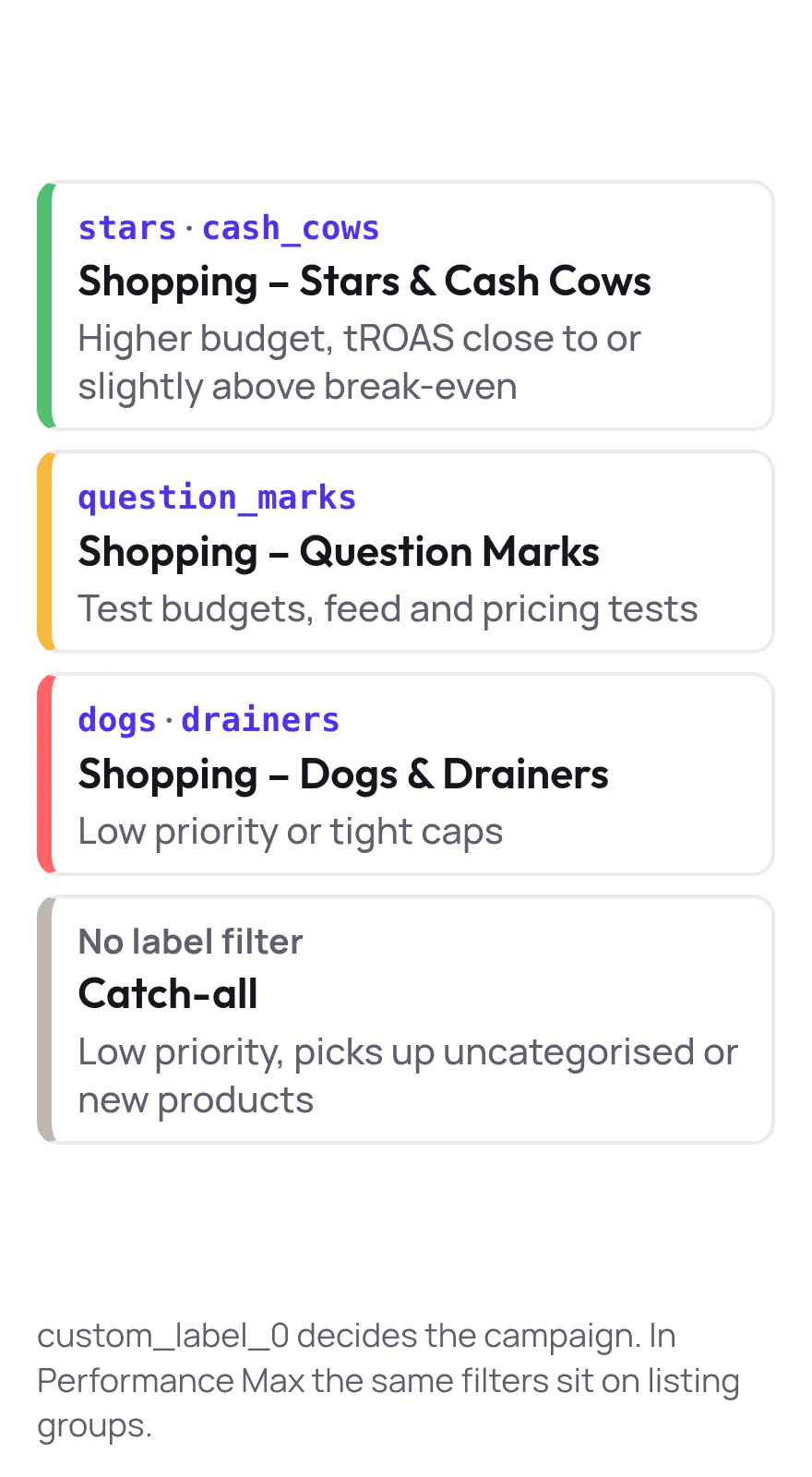
_Each custom_label_0 value lands in exactly one campaign, and the catch-all picks up whatever has no label yet._
For Performance Max, the same label logic applies to **listing groups** inside asset groups instead of product groups. (Source: [Google Ads API – Listing groups for Performance Max](https://developers.google.com/google-ads/api/performance-max/listing-groups))
## 5. From Evaluation to Product Metrics Pilot in 14 Days
Here’s a practical, low‑risk timeline for moving from “tool evaluation” to a live pilot.
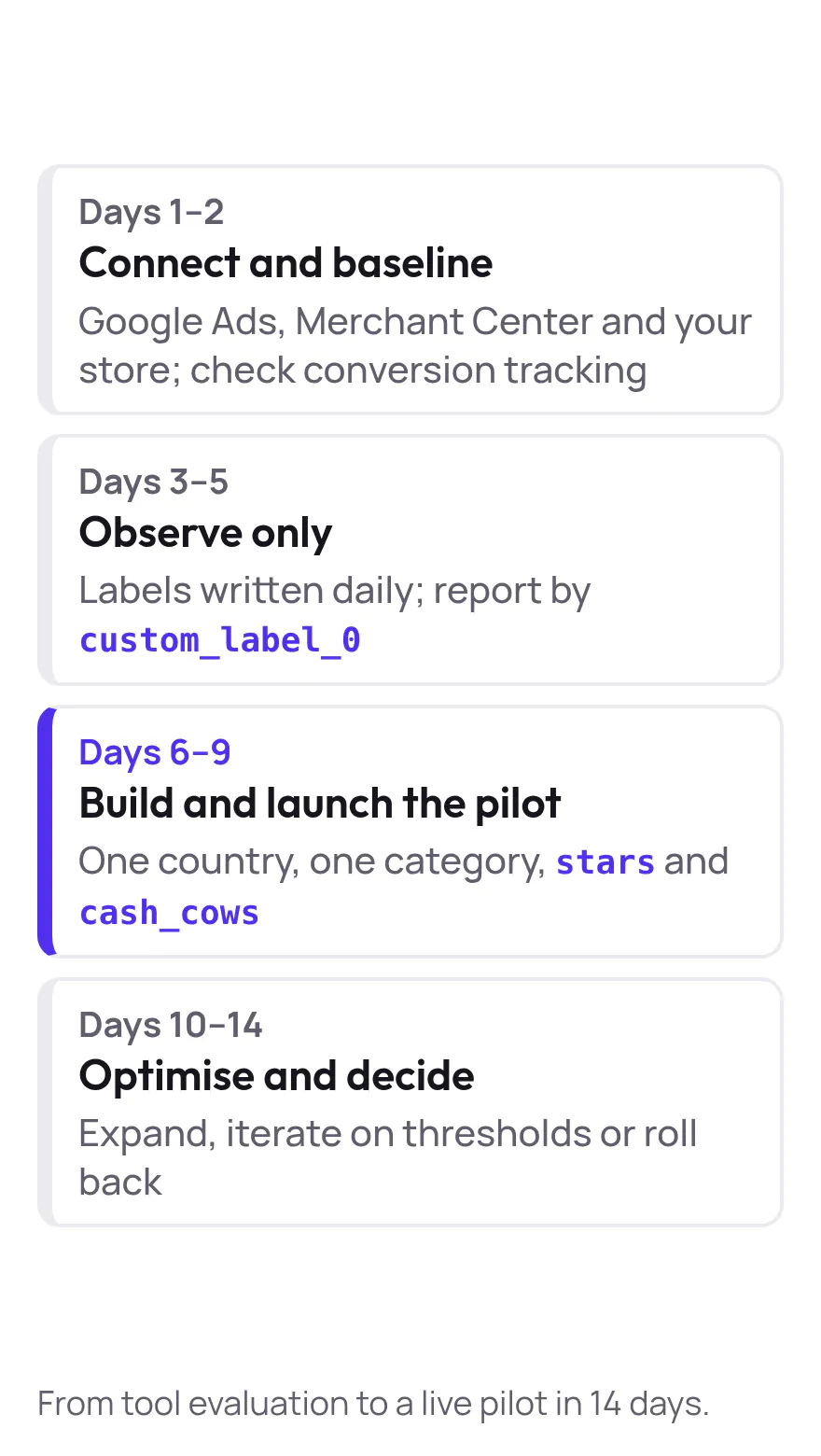
_The pilot campaigns only launch on day 6: the first five days are connecting, baselining and watching the labels._
### Days 1–2 - Connect and Baseline
- Connect Google Ads, Merchant Center, and your store to Product Metrics.
- Confirm conversion tracking is healthy; Product Metrics’ Full Signal Tracking can help patch [gaps from ad blockers](https://www.productmetrics.io/ad-blocker-conversion-tracking) and tracking issues so your segmentation is based on real data. (Source: [Product Metrics – Product-Level Optimization](https://www.productmetrics.io/))
- Export current product group performance and label a first cut of Stars/Dogs/etc. (or let Product Metrics run its segmentation).
### Days 3–5 - Observe Only
- Let Product Metrics segment your products daily into the six segments and write labels to Merchant Center. (Source: [Product Metrics – Google Shopping ads](https://www.productmetrics.io/google-shopping-ads))
- In Google Ads, start reporting by `custom_label_0` on the Product groups / Listing groups pages to understand where budget and returns concentrate.
### Days 6–9 - Build and Launch the Pilot
- Choose one country and one key category.
- Create new Shopping/PMax campaigns filtered on `custom_label_0 in (stars, cash_cows)`.
- Mirror budgets and tROAS from the old campaigns, then apply small, deliberate changes (e.g., slightly higher bids for Stars, tighter control on Dogs).
- Exclude those label values from legacy campaigns.
### Days 10–14 - Optimize and Decide
- Compare performance for the pilot vs. baseline at **segment level**, not campaign total.
- Use simple rules (or scripts) to:
- Protect downside: pause or cap low‑return label groups
- Nudge upside: increase bids where Stars/Cash Cows beat their [break-even ROAS](https://www.productmetrics.io/blog/break-even-roas-per-product)
- Decide whether to:
- Expand coverage (add Question Marks / Dogs)
- Iterate on label thresholds
- Or roll back (easy if you’ve kept legacy campaigns intact)
If the pilot shows at least neutral ROAS with **better control over where budget goes**, you have a strong case internally to expand.
## 6. FAQ - Buying and Piloting a Google Shopping Segmentation Solution
“Where can I buy software for advanced Google Shopping campaign segmentation by product group relevance?”
Look for tools that:
- Segment at **product level** by clicks and profitability (ROAS or POAS)
- Write segments into **Merchant Center custom labels** so they plug into your existing Shopping and Performance Max structure
- Let you keep control of bidding strategies and budgets instead of being a black‑box bidder
Product Metrics is built specifically for this: it segments each product into six performance segments and writes those segments as custom labels you can use directly in Google Ads. (Source: [Product Metrics – Product Segmentation](https://www.productmetrics.io/))
“How do I order a Google Shopping campaign segmentation solution with low risk?”
Instead of a full rebuild, start with:
1. A **14‑day pilot** on one market and one category
2. Labels only in week one (no structural changes)
3. A limited **Stars/Cash Cows** pilot campaign in week two
4. Clear rollback steps documented in your change log
Because Product Metrics only changes labels in Merchant Center and doesn’t touch your bids or budgets, you can always revert by switching campaigns back to your legacy product groups. (Source: [Product Metrics – Google Shopping ads](https://www.productmetrics.io/google-shopping-ads))
“What if I already use scripts and spreadsheets?”
Keep them. This playbook doesn’t replace your tooling; it gives you **better segmentation inputs**. Many advertisers use:
- Product Metrics for **segmentation and labels**
- Native Google Ads rules and scripts for **bidding and budget moves**
- Spreadsheets/BI for **reporting and forecasting**
## 7. Next Steps
If you’re managing Shopping and PMax at scale, you’re already doing the hard work: clean feeds, solid tracking, and constant tuning. The missing piece is often **a stable, automated way to group products by relevance**.
With the playbook above you can:
1. Add relevance labels with almost no risk
2. Prove the value of segmented product groups on a narrow pilot
3. Let Product Metrics keep labels in sync while your existing rules and scripts do what they do best
When you’re ready to see your own Stars, Cash Cows, Dogs and Drainers:
- **[Analyse your products for free](https://app.productmetrics.io/)** and see every product’s segment and break-even in one place. (Source: [Product Metrics – Product-Level Optimization](https://www.productmetrics.io/))
- Or **book a demo** to walk through a pilot plan tailored to your account.
That’s a playbook a PPC specialist can share with their team today—and ship in production over the next two weeks.
## Keep reading.
- [Tool-By-Use-Case: Best Software for Clear Reporting in Shopping/PMax (Small Catalogs, Large Feeds, and Multi-Brand)](https://www.productmetrics.io/blog/shopping-pmax-reporting-software)
- [Google Shopping and PMax campaign structure by profit](https://www.productmetrics.io/blog/product-segmentation-google-shopping-pmax)
- [Campaign Segmentation in Google Shopping - Principles, Pitfalls, and Governance](https://www.productmetrics.io/blog/campaign-segmentation-google-shopping)
---
Written by Berend Vrakking, founder of Product Metrics. Last updated 2026-11-09.
1M+ products analysed · Nominated at the Dutch Search Awards for Best Measurement Campaign (2023) and Best Use of Data (2024)
HTML version: https://www.productmetrics.io/blog/segment-google-shopping-by-product-group