 Log in with Google
Ad campaign names: 8 examples for clearer reporting
Ad campaign names that read at a glance: a campaign naming convention for Google Ads, Shopping and PMax, eight examples and a change record your team can keep.
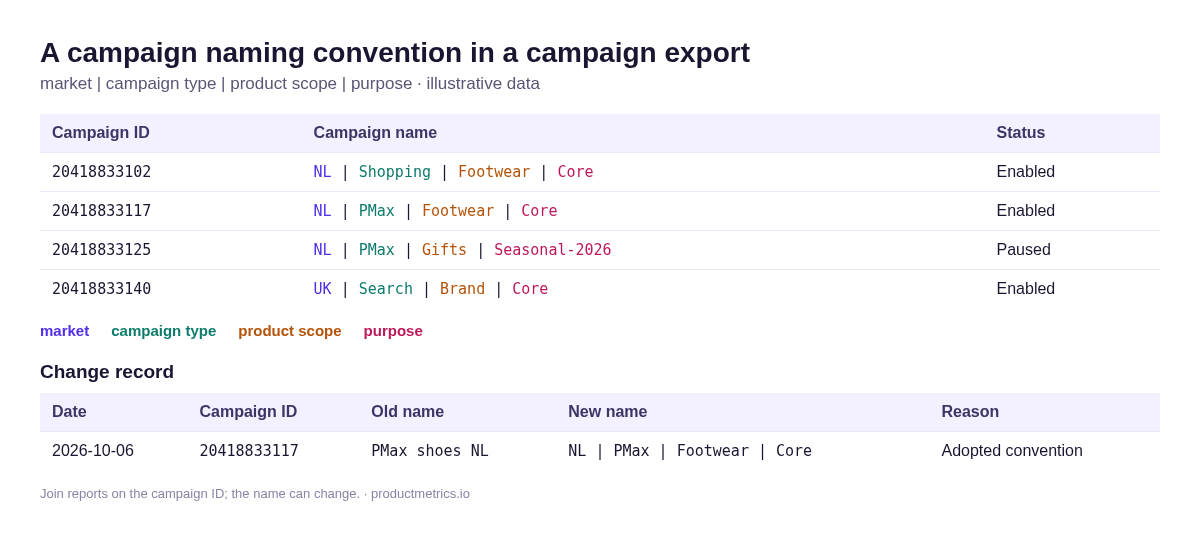
A campaign name is the label that identifies a campaign in Google Ads tables, reports and exports. A campaign naming convention is the fixed order of fields every campaign name follows, so anyone reading an export can tell what a campaign covers. For a shop, market | campaign type | product scope | purpose works: NL | Shopping | Footwear | Core.
The name describes the setup; it doesn’t configure it. Keep it stable, and keep anything that changes, such as margin or stock, in product data where it can move.
What should a campaign naming convention include?
Include a field only when it helps someone interpret the spend. Start with the market, campaign type, product scope and purpose; add a test reference when there is a specific experiment to track.
| Field | Example value | Question it answers |
|---|---|---|
| Market | NL | Which market is this intended to serve? |
| Campaign type | Shopping | Which kind of campaign is this? |
| Product scope | Footwear | Which products should be eligible? |
| Purpose | Core | Why does this campaign exist? |
| Optional test reference | Test-03 | Which documented test does it belong to? |
Google does not require this format. Agree the field order and separator with your team, and write down any abbreviations a new colleague would need explained.
If scripts or integrations create campaigns, consult the Google Ads API campaign overview for the campaign resource. Keep your naming dictionary alongside the integration’s configuration.
For NL | Shopping | Footwear | Core, check the market settings and eligible footwear products before using the name. The Google Shopping management guide covers those setup checks.
What are good ad campaign name examples?
Choose examples that describe campaigns you actually need for Performance Max, Shopping and Search. A naming template is not a reason to split an account into eight campaigns.
| Example name | Intended scope | Check before using it |
|---|---|---|
| NL | Shopping | Footwear | Core | Ongoing footwear campaign | Eligible products match the scope |
| DE | Shopping | Homeware | Core | German-market homeware campaign | Market, language and landing pages agree |
| NL | PMax | Footwear | Core | Ongoing footwear Performance Max campaign | Listing groups include the intended products |
| NL | PMax | Gifts | Seasonal-2026 | Seasonal gift campaign | Dates and product availability are documented |
| UK | Search | Brand | Core | Brand-focused Search campaign | Keywords and exclusions match the stated purpose |
| UK | Search | Running-shoes | Generic | Non-brand product-search campaign | Search terms support that description |
| NL | Shopping | Clearance | Stock-run-down | Campaign for selected clearance products | Product labels and margin support eligibility |
| NL | PMax | Footwear | Test-03 | Campaign connected to a documented test | Test owner, hypothesis and review date exist |
These names are illustrative. Before calling a campaign Brand, check its traffic; before adding Test-03, make sure the test has a hypothesis, owner and review date.
For Performance Max campaign structure, decide which products belong together before deciding what to call the campaign. Keep asset-group names consistent with the campaign’s scope, while documenting their more specific creative or product role.
Use Google’s Performance Max overview as background on the campaign type, then check that each name describes the actual setup.
What should stay out of a campaign name?
Store margin, stock and current performance where they can change without rewriting the campaign’s identity. A name such as High-margin winners becomes misleading when its products or economics change.
| Information | Better home | Reason |
|---|---|---|
| Market and campaign type | Campaign name and settings | Stable scope that staff need to scan |
| Margin band | Product data or approved custom label | Products can move between bands |
| Stock availability | Product data and inventory reporting | Availability changes with sales and replenishment |
| Current target ROAS | Campaign settings and change record | Targets can change during the campaign’s life |
| Creative slogan | Ad assets and creative documentation | Customer-facing language has a different purpose |
Google documents custom labels for grouping products. Agree which label field holds which meaning before changing it; another campaign or feed process may already depend on that field.
Product Segmentation writes approved segment labels that configured campaigns use. Naming the campaign after a segment does not make that connection happen automatically. Check label values, product eligibility and campaign configuration together.
How do you keep campaign names consistent?
Document allowed values and use the campaign ID to join reports. Human-readable names can change; using the name alone as a reporting key makes comparisons fragile.
| Rule | Example | Maintenance check |
|---|---|---|
| One field order | Market, type, scope, purpose | Every export follows the same order |
| One vocabulary | PMax rather than three variants | New campaigns use the dictionary |
| One separator | A vertical bar between fields | Field values do not contain that separator |
| Recorded renames | Old name, new name, date, reason | Historical reports remain explainable |
Keep a short mapping from campaign IDs to current names, and retain dated changes. Before bulk renaming, check spreadsheets, dashboards, filters and scripts that search for text in names. A cosmetic cleanup can still break a report that depends on that text.
Naming also cannot tell you whether a target is affordable. Check the product’s advertising floor with the break-even ROAS calculator before choosing a target, then record the target in the campaign settings.
Use a separate performance review to decide what should change: the ROAS improvement guide covers that process, while POAS versus ROAS explains when margin changes the interpretation of revenue return.
Final thoughts
Try the convention on one campaign family. Hand the export to a colleague and ask them to find the market, products and purpose. Any field they have to ask about needs a clearer name or a note in the dictionary.
Once that works, use the same vocabulary across Shopping performance reviews. Keep campaign identity stable while product-level evidence explains which products deserve higher or lower priority.
Customer-facing language is a different job: for the creative side of naming, this 2011 report on slogan research is historical reading about how people respond to slogans.
Keep reading.
Google Ads optimisation for Shopping and PMax
Optimise Google Ads Shopping and Performance Max in order: fix conversion tracking, structure, bidding, tests, then judge each product by profit.
Product journey map for Shopping and Performance Max
A product journey map for Shopping and Performance Max links the product clicked in an ad to the products bought, and shows the contribution behind it.
Demand Gen vs Performance Max for ecommerce
Demand Gen vs Performance Max for ecommerce: which products each campaign type should carry, and how to read each against its own break-even ROAS.
Frequently asked questions.
Should asset groups follow the same convention?
Does renaming a campaign change its targeting?
Should I put target ROAS in campaign names?
See which of your products to push, fix or pause. Start with your own products, or a 30-second estimate.
Check one product first: work out its break-even ROAS in the calculator. Then see where all your products stand.
Questions, or want to spar about your products? Book a demo: a video call with Berend, then a demo account.