 Log in with Google
Price monitoring software compared for Google Shopping
Ten ways to monitor prices compared on cost at 1,000 products, matching and update frequency: Merchant Center, Prisync, Pricefy, Wiser, Minderest and more.
Price monitoring software checks competitors’ prices for your products on a schedule and shows where you sit. For Google Shopping merchants three things decide the choice: whether your products match without a GTIN, how often prices update, and what it costs at your product count. At 1,000 products, the monthly plans we found cost $99 to $599, and Competitor Prices costs €16.00 checked weekly or €120.00 daily, excl. VAT.
We make Competitor Prices. Everything about Google’s free option and the other tools comes from their own pages; where a page is silent, the table says “not stated” rather than guessing.
What is price monitoring software?
It is a tool that collects competitors’ prices, matches them to your products and tracks changes over time. Three jobs sit under the name. Monitoring shows the prices. Intelligence adds analysis, such as your price position. Repricing changes your prices by rule. What price intelligence is untangles the three; this post compares tools that do the first, and sometimes the others.
Which price monitoring tool is best for Google Shopping?
None wins for every shop, because the tools target different buyers. Each is described in its maker’s own words:
| Pricing as stated | Matching as stated | Update frequency | |
|---|---|---|---|
| Google Merchant Center | Free | Same GTIN only | Latest prices only |
| Prisync | $99 to $799 a month by model and plan; 14-day free trial | URL-based, channel-based or hybrid; matching service on order | Up to 3 times a day for URLs, daily for channels |
| Pricefy | Free (50 SKUs); $49 to $499 a month | Barcodes first, then AI matching | Daily, 1 or 2 times |
| Price2Spy | Not stated for Starter and Basic; Premium on request; 14-day free trial | “Quick match” on Starter, product variations on Basic, a matching service | Up to 8 checks a day on Premium; not stated otherwise |
| Wiser | Not stated; contact sales | Automatic matching to direct competitors | As often as every 15 minutes |
| Minderest | Not stated; demo | Automatic and manual; identical, similar or white-label products without a product code | Daily |
| Competera | Not stated | Not stated | Not stated in general |
| Omnia Retail | Not stated; depends on the size of your range | Not stated | Not stated |
| Skuuudle | Quote-based | Managed by Skuuudle, or import your own matches | Daily and weekly most popular; up to hourly |
| Competitor Prices | €0.004 per check, excl. VAT | Own-brand alternatives on dimensions you approve | Daily, weekly or monthly |
Read the table by buyer. Merchants with branded, GTIN-coded products can start free with Merchant Center and add a tool when they need competitor-level detail. Teams that know which competitor pages to follow suit Prisync. Large retailers with a pricing team look at Wiser, Competera or Skuuudle, which sell through sales conversations. Shops that want repricing rules look at Pricefy or Omnia Retail. Own-brand merchants need the matching column first.
How much does price monitoring software cost?
It depends on products and how often you check, and vendors state it in different currencies and units. Prisync and Pricefy publish monthly plans in US dollars; Competitor Prices charges €0.004 per check, excl. VAT. To compare like for like, take 1,000 products:
| Option | Plan at about 1,000 products | Cost a month | Updates |
|---|---|---|---|
| Google Merchant Center | Pricing tab, GTIN products only | Free | Latest prices |
| Pricefy Pro | Up to 2,000 SKUs (Starter stops at 100) | $99 ($74 on yearly billing) | Twice a day |
| Prisync, URL-based | Premium, up to 1,000 products | $199 | Not stated for this plan |
| Prisync, channel-based | Premium, one sales channel included | $399 | Not stated for this plan |
| Prisync, hybrid | Premium, one sales channel included | $599 | Not stated for this plan |
| Competitor Prices, weekly | 4,000 checks | €16.00 | Weekly |
| Competitor Prices, daily | 30,000 checks | €120.00 | Daily |
| Price2Spy, Wiser, Minderest, Competera, Omnia Retail | Not published on the pages we checked | Not stated | See the table above |
| Skuuudle | Quote-based | Not stated | Daily to hourly |
Competitor Prices at 1,000 products: cost a month by check frequency (€, excl. VAT)
Show the dataHide the data
| Check frequency | Cost a month |
|---|---|
| Monthly (1,000 checks) | €4.00 |
| Weekly (4,000 checks) | €16.00 |
| Daily (30,000 checks) | €120.00 |
Published monthly plans for about 1,000 products (US dollars)
Show the dataHide the data
| Plan | Cost a month (US$) |
|---|---|
| Pricefy Pro | 99 |
| Prisync URL-based | 199 |
| Prisync channel-based | 399 |
| Prisync hybrid | 599 |
Three cautions apply:
- Currencies differ. Dollars and euros are not interchangeable, so convert at your own rate before comparing.
- Plans bundle different things. Prisync adds sales channels at $100 or $200 a month each and charges 20% on top for API access. Pricefy adds repricing from its Pro plan.
- Cost scales differently. A flat plan covers a range for a fixed fee, while a per-check price follows product count and frequency: 5,000 products checked weekly is 20,000 checks, €80.00 a month, and daily it is €600.00. Competitor Prices checks daily at most, so a vendor that updates twice a day is a different service.
Is there a free way to see competitor prices on Google Shopping?
Yes, if your products have a GTIN. Google Merchant Center is free, and its Pricing tab under Analytics compares your price with a benchmark. Google defines the benchmark as “the average price that typically leads to more successful ad auctions, impressions, clicks, or conversions”, taken from all retailers selling the same GTIN in Shopping ads and organic listings.
The price gap is the percentage difference between your price and that benchmark. You need a valid GTIN to get it, so own-brand products without one get no benchmark. Merchant Center shows only the latest prices; for a history, Google points to the Merchant API or BigQuery. If you also report purchase conversions, it adds sale price suggestions (Google Merchant Center Help). Our Merchant Center guide shows how to read the price gap next to break-even.
Can you monitor prices for products without a GTIN?
Yes, but only with a tool that matches in another way. A GTIN lookup finds the same barcode elsewhere, and an own-brand product has no twin. The tools take four routes:
- Barcode first, then AI. Pricefy says it first tries EAN, GTIN and UPC matching, then falls back to AI comparison of text and images.
- You supply the URLs. Prisync tracks the competitor product pages you add, one by one or in bulk, and sells a matching service.
- The vendor matches for you. Skuuudle says it handles matching end to end; Price2Spy lists a product matching service.
- Similar products. Minderest says it matches identical, similar or white-label products without a product code. Competitor Prices matches competitors’ own-brand alternatives by style, colour and custom dimensions that you approve.
Ask any vendor to match ten of your own-brand products before you pay.
Which Google Shopping coverage do the tools state?
Prisync, Pricefy, Minderest and Omnia Retail name Google Shopping on their own pages, and Competitor Prices is built for it.
| Tool | What its own page says |
|---|---|
| Prisync | A Google Shopping page: it “tracks specific competitors appearing in Google Shopping listings for your products” |
| Pricefy | Marketplace analysis: “Track Amazon, eBay and Google Shopping” |
| Minderest | Monitors “price comparison sites such as Google Shopping, marketplaces such as Amazon or eBay” |
| Omnia Retail | “Omnia connects to Google Shopping, Amazon, eBay, Bol.com, Kaufland, and more” |
| Price2Spy | Lists a Google Shopping feed integration; the page does not say what data it covers |
| Wiser | You choose competitors and marketplaces to track; the page does not list which channels it covers |
How do the tools differ?
They differ most in how they price and how they match products.
Prisync suits teams that know which competitor products to follow. It has three models, each with plans for up to 100, 1,000 or 5,000 products. Every plan has a 14-day free trial, and API access costs 20% on top of the subscription on Premium and Platinum.
| Prisync model | 100 products | 1,000 products | 5,000 products |
|---|---|---|---|
| URL-based: you add competitor URLs | $99 | $199 | $399 |
| Channel-based: one sales channel included | $199 | $399 | $599 |
| Hybrid: channels plus URLs | $299 | $599 | $799 |
Pricefy is the easiest to try, because the free plan has no end date: 50 SKUs and 5 competitors, updated once a day. Paid plans run from 100 SKUs at $49 a month to 25,000 at $499, updated twice a day, and yearly billing saves 25%. Dynamic repricing starts on the $99 Pro plan.
Price2Spy offers a 14-day free trial without a credit card. Its tiers differ by features, from a “Quick match” Starter plan with up to 10 competitors to a Premium plan with up to 8 price checks a day. Starter and Basic prices are not stated on the pages we checked.
Wiser positions itself for large retailers and brands. It refreshes competitor prices as often as every 15 minutes, matches products automatically and does not publish prices.
Minderest most directly addresses products without a shared code. It collects prices daily, sells through a demo and does not publish prices.
Competera targets enterprise retail and presents case studies, such as 95%+ matching accuracy for 180,000 items across more than 150 competitors for one customer. It does not publish prices or describe its matching method.
Omnia Retail serves retailers and brands of all sizes, connects to marketplaces such as Bol.com and Kaufland, and builds pricing rules in a strategy tree. Prices depend on the size of your range and are not published.
Skuuudle sells to retailers, brands and manufacturers. Matching is managed by the vendor, collection runs daily or weekly for most customers and can go up to hourly, and packages are quoted per project.
Where Competitor Prices fits
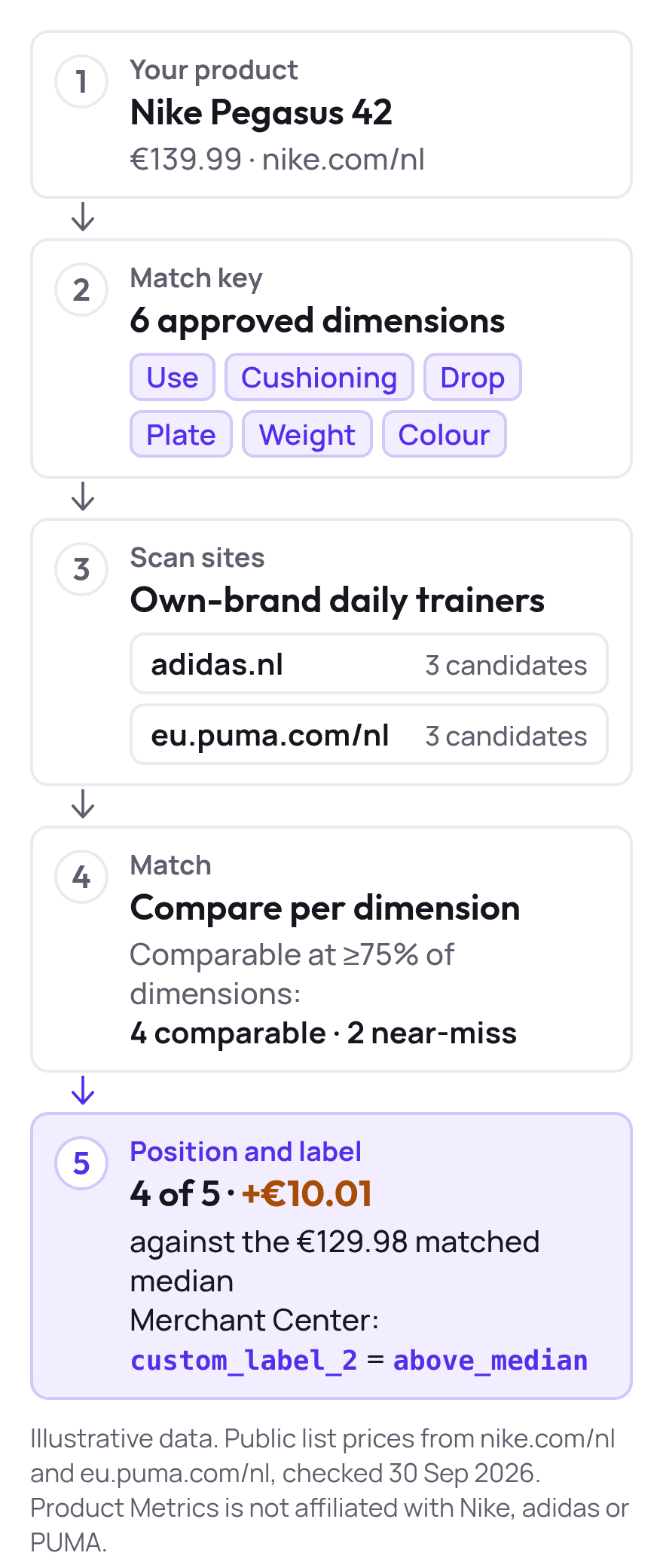
Minderest matches white-label products for retailers in general; Competitor Prices is built for merchants running Google Shopping with own-brand products. AI suggests dimensions, you approve them, and it matches competitors’ own-brand alternatives. It checks daily, weekly or monthly at €0.004 per check, excl. VAT. Your price position then sits next to POAS, margin and stock, and goes back to Merchant Center as a custom label. It compares list prices without shipping, and pricing stays your call: it never changes prices.
How do you choose price monitoring software?
Four questions narrow the field quickly.
- Count the products you need to trackPaid plan limits start at 100 products and rise to tens of thousands, so your range sets the shortlist.
- Decide how products are matchedBranded products share a GTIN. Own-brand products don't, so check for URL mapping, white-label matching or dimension matching.
- Check how often prices updateDaily is enough for most categories. Pay for faster refresh only where prices move within the day.
- Decide where the data goesA dashboard shows what changed. Whether it matters only becomes visible once price position sits next to margin and POAS.
If you track only a few products, start with a spreadsheet: our competitor price analysis template has the formulas. How to track competitor prices for Google Shopping walks through the set-up, and competitive pricing examples shows when to price above, at or below the median.
Start with the free gap
Check your Merchant Center price gaps first; they are free. Then shortlist two tools and test each on ten of your own products, including one own-brand product. When price position next to POAS is what you need, see Competitor Prices.
Sources
Prices are list prices as the vendors show them, in US dollars unless stated; nothing was tested inside the products.
- Google Merchant Center Help, About Pricing in Merchant Center Analytics and Get started with Merchant Center.
- Prisync, plans and pricing and Google Shopping monitoring.
- Pricefy, pricing and home page.
- Price2Spy, pricing and home page.
- Wiser, Wiser Price Intelligence product page.
- Minderest, AI Price Intelligence and competitor price monitoring.
- Competera, home page.
- Omnia Retail, home page.
- Skuuudle, home page and pricing.
- Competitor Prices facts come from its product page and the Price Monitoring rate on the pricing page.
Keep reading.
Competitor price analysis template (free spreadsheet)
Download a free competitor price analysis template: compare your prices with three competitors, see price position and ratio, and log changes weekly.
How to track competitor prices for Google Shopping
Track competitor prices when nobody sells your product: match own-brand products by dimensions, compare list prices, then read price position next to POAS.
What is price intelligence? A Google Shopping guide
Price intelligence turns competitor prices into context for pricing and ad decisions. See the data it needs, three Shopping use cases and a worked example.
Frequently asked questions.
Which price monitoring software is cheapest?
Does Google Merchant Center show competitor prices?
Can price monitoring software match own-brand products?
How often should prices be checked?
Is a per-check price cheaper than a monthly plan?
Does price monitoring software change my prices?
Do I need price monitoring software at all?
See which of your products to push, fix or pause. Start with your own products, or a 30-second estimate.
Check one product first: work out its break-even ROAS in the calculator. Then see where all your products stand.
Not ready to connect? Book a demo: a video call with Berend, then a demo account.