
Best Google Ads Conversion Tracking Apps for Shopify
Best Google Ads conversion tracking apps for Shopify, scored on five criteria: Littledata, Elevar, Nabu, Analyzify, Stape and Google’s own app.
Google Ads conversion tracking on Shopify is how each sale in your store gets reported to Google Ads, so its automatic bidding (Smart Bidding) learns which ads sell. When orders go missing on the way, Google Ads learns from only part of your sales.
I scored six options on five weighted criteria, using vendor docs and Shopify App Store listings from November 2026. You get:
- a weighted score per app, with its inputs
- prices as listed this month
- a pick for each situation
Why Google Ads conversion tracking breaks on Shopify
Google Ads conversion tracking breaks on Shopify for three reasons: tracking code pasted into checkout no longer runs, tracking waits for the shopper’s consent, and ad blockers stop tracking in the browser.
Google calls the Google & YouTube app “the easiest way to set up conversion tracking” on Shopify. It asks you to remove older tracking code so orders aren’t counted twice. (Source: Google Ads Help)
Shopify now runs checkout tracking through apps and its own pixels. The “Additional scripts” box for pasted code became view-only on 28 August 2025. Pasted code stopped running on the order status page that day for Shopify Plus, and on 26 August 2026 for every other plan. (Source: Shopify Help Center; Shopify.dev)
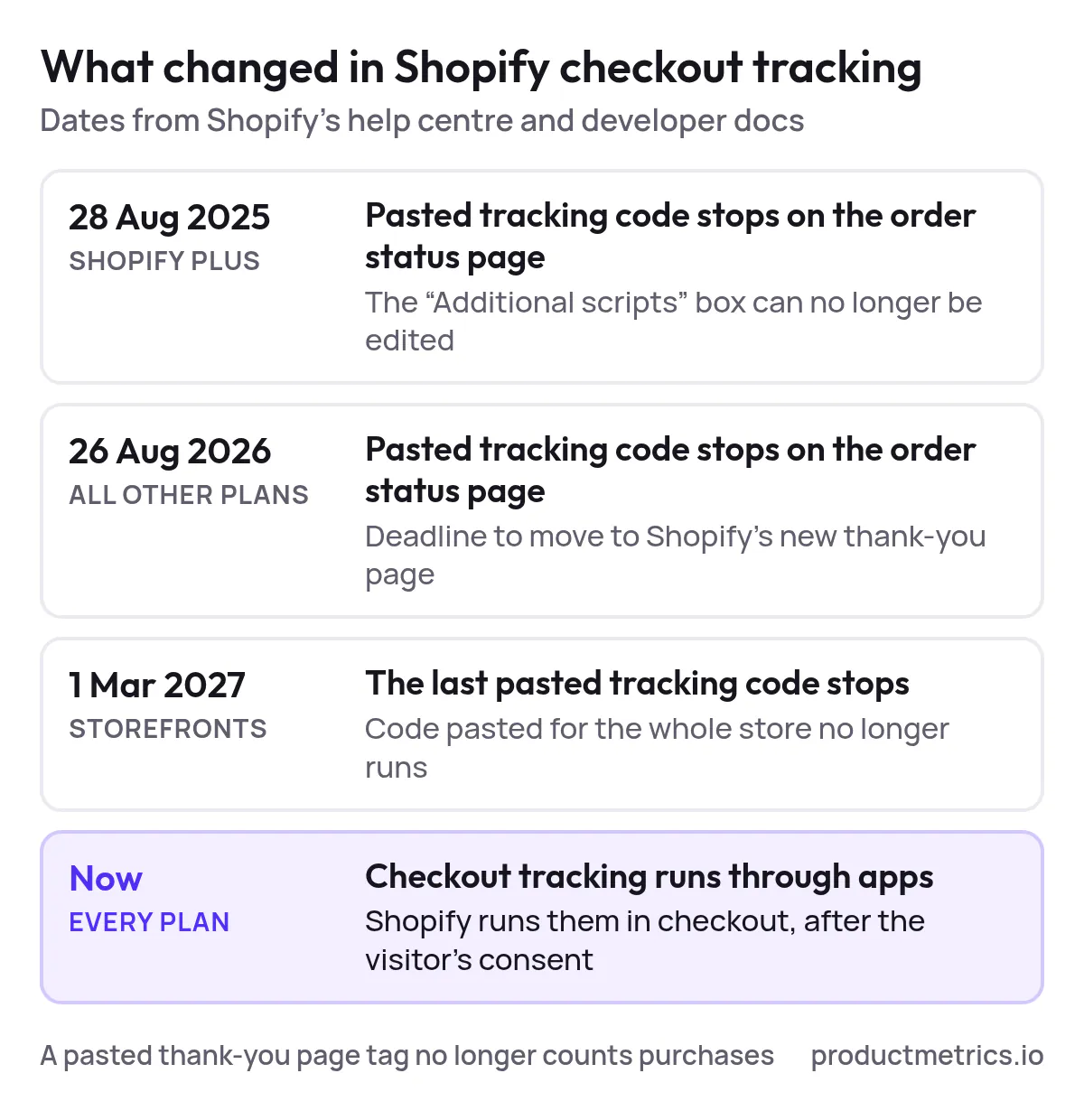
These pixels run on the store, checkout and thank-you pages. Where the law asks for consent, as in the EEA and the UK, they wait until the shopper agrees. (Source: Shopify Help Center)
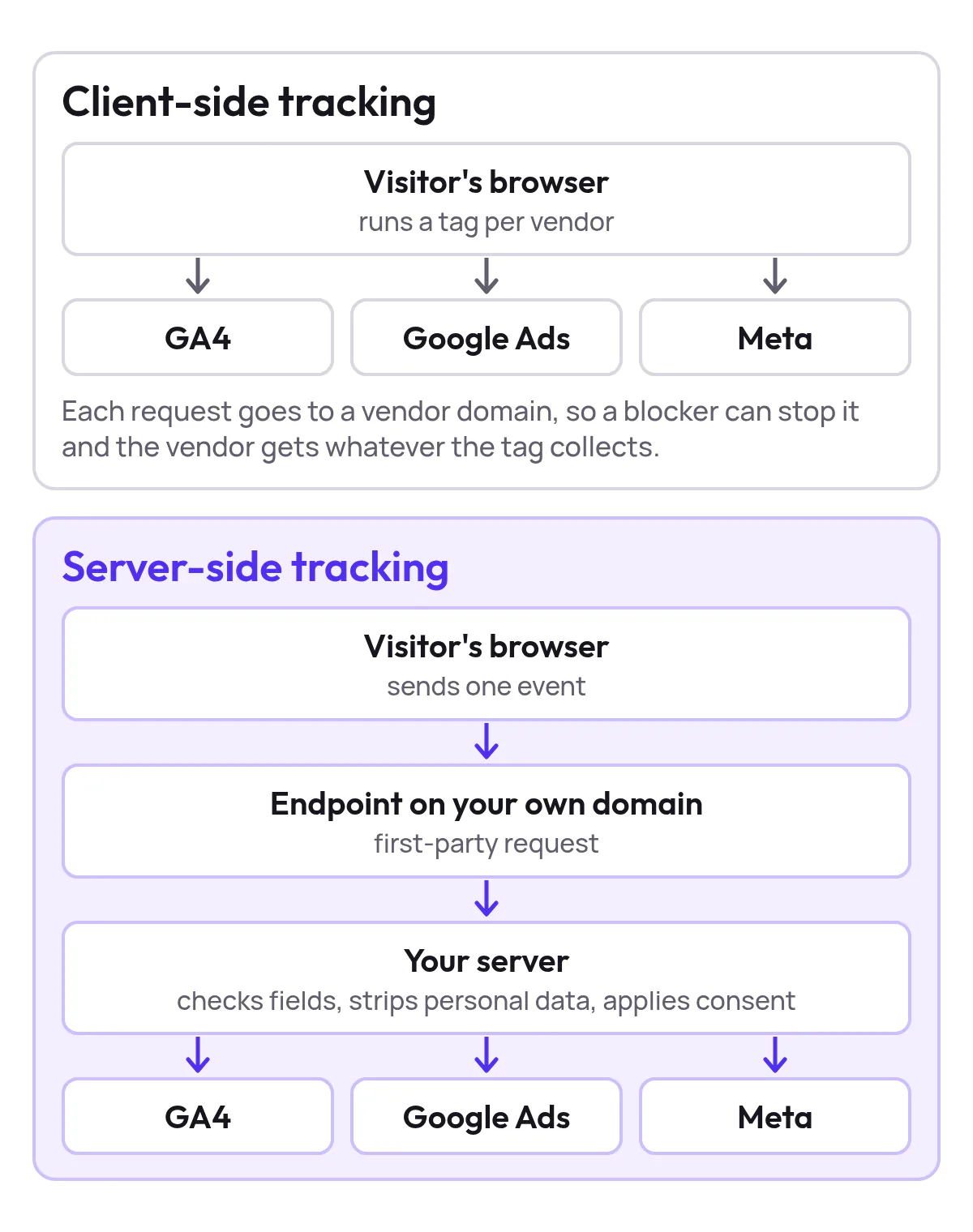
A pixel still runs in the shopper’s browser. Ad blockers stop Google’s standard tags (try our ad blocker test), and Safari forgets the ad click after 7 days. Server-side tracking reports the purchase from a server instead.
How we evaluated Shopify conversion tracking apps
We judged each app on what reaches Google Ads after a Shopify purchase.
- Platform integration depth
How closely the app works with Shopify, and which orders it sees. - Conversion completeness
How many real purchases reach Google Ads despite ad blockers, declined cookies and Safari’s 7-day limit. - Signal depth
What Google Ads learns about each order: revenue, profit, new or returning customer, lifetime value and refunds. - Setup effort and maintenance
The work to set it up and keep it running, including Google Tag Manager, Google’s tool for managing tracking code. - Price and fit
The published price for a typical store, and who the app is built for.
Everything here is based on vendor docs and public listings available as of November 2026.
Scoring rubric
Each app gets a score from 1 to 5 per criterion. The weighted score adds up each score times its weight, rounded to one decimal.
| Criterion | What it means | Weight |
|---|---|---|
| Platform integration depth | App Store app, Shopify pixels, order data | 25% |
| Conversion completeness | Ad blockers, cookie consent, Safari, server-side | 25% |
| Signal depth | Revenue, profit, new vs returning, lifetime value, refunds | 20% |
| Setup effort and maintenance | Install steps, tag setup, upkeep | 15% |
| Price and fit | Published price and target store | 15% |

Show the dataHide the data
| Criterion | Weight |
|---|---|
| Platform integration depth | 25% |
| Conversion completeness | 25% |
| Signal depth | 20% |
| Setup effort and maintenance | 15% |
| Price and fit | 15% |
The tools at a glance
Six options cover most Shopify stores: one free baseline and five apps.
Baseline:
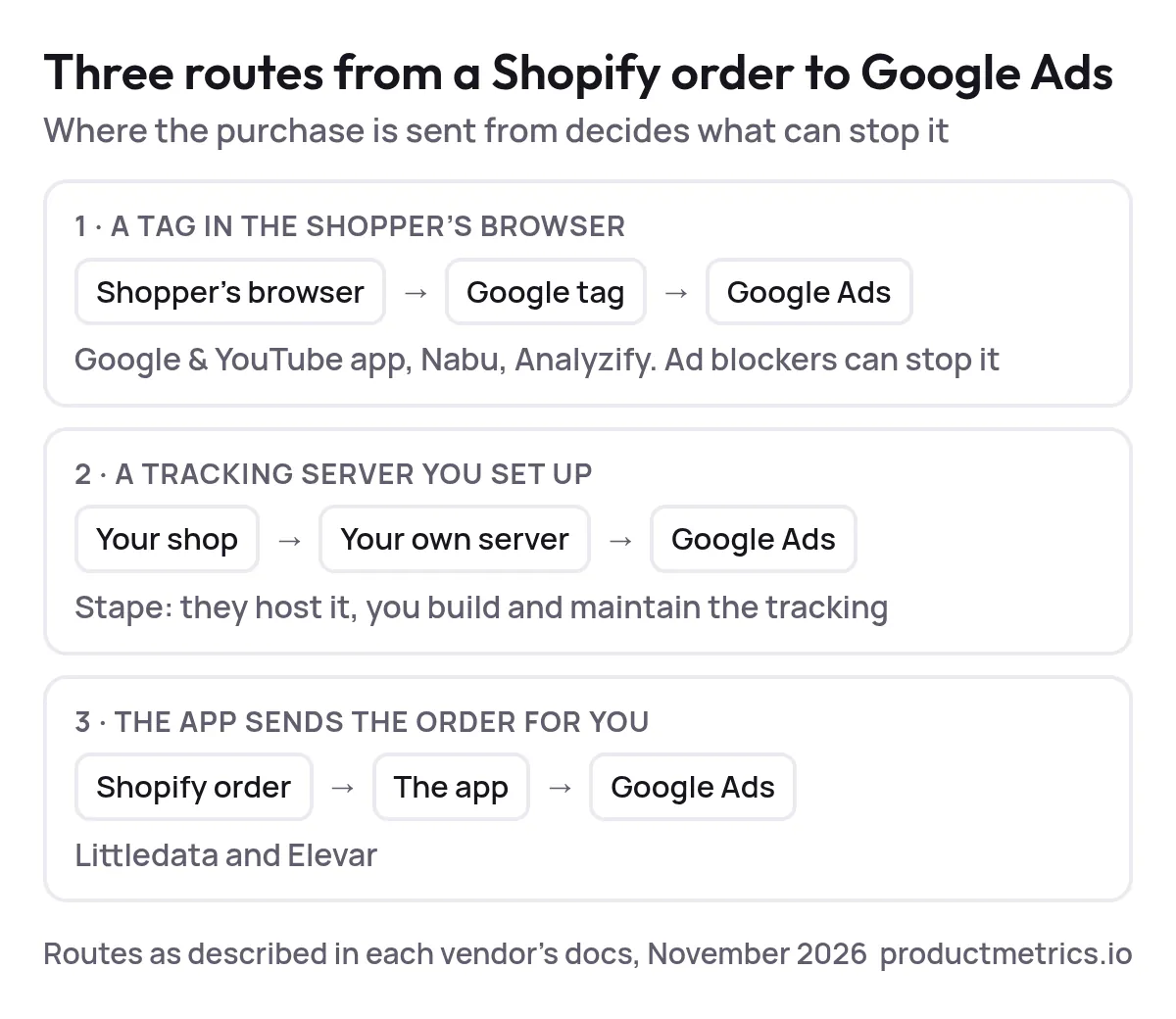
- Google & YouTube app: Google’s free app sends your products to Google Merchant Center and adds Google’s tag. (Source: Shopify App Store)
Third-party apps:
- Littledata: sends every order from a server, without code. (Source: Littledata)
- Elevar: sends purchases from a server to many ad and email platforms. (Source: Shopify App Store)
- Nabu: Google Ads Pixel: adds a low-cost Google Ads tag. (Source: Shopify App Store)
- Analyzify: sets up Google Analytics 4 (GA4) and Google Ads tracking for you. (Source: Shopify App Store)
- Stape Conversion Tracking: hosts a tracking server you set up yourself. (Source: Shopify App Store)
Google & YouTube app – the free baseline
Best for: every Shopify store, as the free base for Google Merchant Center and a first Google Ads tag.
The Google & YouTube app is Google’s own Shopify app, launched on 28 November 2017 and rated 4.5 from 5,605 reviews. It syncs your products, deals and shipping to Merchant Center, the source of your Google Shopping ads, and adds the Google tag. (Source: Shopify App Store)
| Google & YouTube app | As listed, November 2026 |
|---|---|
| Install | Shopify App Store, by Google |
| Sends to Google Ads | Purchase, add to cart and checkout started by default |
| Server-side | Not described on the listing or in Google’s help |
| Price | Free to install |
Strengths
- Free, recommended by Google, with enhanced conversions as one setting: the shopper’s scrambled email helps Google Ads match more orders to its ads.
- Keeps your products in Merchant Center, which every other app leaves to it.
Limitations
- It links one Google Ads account; more accounts, including those under an agency’s manager account, need manual setup. (Source: Google Ads Help)
- Neither the listing nor Google’s help mentions profit or new-customer values, and the tag runs in the shopper’s browser.
Scores
- Platform integration depth: 5/5
- Conversion completeness: 2/5
- Signal depth: 1/5
- Setup effort and maintenance: 4/5
- Price and fit: 5/5
For Google Ads conversion tracking on Shopify at no cost, start here.
Littledata – server-side Enhanced Conversions for Shopify
Best for: Shopify brands that want orders sent from a server to GA4, Google Ads and Meta, with no code.
Littledata reports every order from Shopify’s servers, including subscriptions, in-store sales and post-purchase upsells. It uploads them to Google Ads as enhanced conversions, matched to your tag on the Shopify order so none counts twice. (Source: Littledata)
| Littledata | As listed, November 2026 |
|---|---|
| Install | Shopify App Store, Built for Shopify, about 10 minutes |
| Sends to Google Ads | Purchases with scrambled customer details; new vs returning customers |
| Server-side | Yes, from Shopify’s servers |
| Price | $0.35 per order (Flex) or $199 a month for 1,500 orders (Scale) |
Strengths
- “No GTM, no devs needed”, and it can run as a secondary conversion beside the Google & YouTube app while you compare the two. (Source: Shopify App Store)
- Profit Signal takes shipping, taxes, fees and product costs (COGS) off the revenue and sends the rest as the order’s value.
Trade-offs
- Profit Signal is labelled beta, and combining your tag with Littledata’s data is still a Google Ads beta.
- Per-order pricing grows with your order count rather than with your results.
Scores
- Platform integration depth: 5/5
- Conversion completeness: 4/5
- Signal depth: 4/5
- Setup effort and maintenance: 5/5
- Price and fit: 3/5
For Shopify server-side tracking for Google Ads that a marketer can set up alone in about 10 minutes, pick Littledata.
Elevar – server-side tracking with many destinations
Best for: Shopify brands sending the same purchases to Google Ads, Meta, GA4, Klaviyo and TikTok.
Elevar Conversion Tracking sends purchases from a server to more than 50 ad, email and analytics platforms, and recognises returning shoppers. Elevar says it recovers “activity lost to ad blockers and browser restrictions”. (Source: Shopify App Store)
| Elevar | As listed, November 2026 |
|---|---|
| Install | Shopify App Store app, connected to your Elevar account |
| Sends to Google Ads | Purchases with enhanced conversions, from the browser and a server |
| Server-side | Yes |
| Price | Free to 100 orders; Core $225 a month for 2,000 orders |
Strengths
- Sends enhanced conversion data “both browser side and via the API”, and can use an existing Google Ads conversion action. (Source: Elevar docs)
- Guided onboarding, and privacy and compliance tools on every plan.
Trade-offs
- Profit optimisation and predicted lifetime value start on the Advanced plan, at $650 a month for 10,000 orders.
- Google Ads access is requested by email, and its conversions start as secondary, which Google Ads doesn’t bid on.
Scores
- Platform integration depth: 5/5
- Conversion completeness: 4/5
- Signal depth: 3/5
- Setup effort and maintenance: 3/5
- Price and fit: 2/5
If you need Shopify server side tracking that feeds every ad and email platform at once, choose Elevar.
Nabu – a one-click Google Ads pixel
Best for: stores and agencies that want a clean Google Ads tag on several accounts for little money.
Nabu: Google Ads Pixel, by AdNabu, adds the Google Ads pixel in one click, with no theme changes. It tracks purchases, add to cart, checkout and post-purchase upsells, with enhanced conversions. (Source: Shopify App Store)
| Nabu | As listed, November 2026 |
|---|---|
| Install | Shopify App Store, Built for Shopify, one click |
| Sends to Google Ads | Purchases, add to cart and checkout, with enhanced conversions |
| Server-side | Not mentioned on the listing |
| Price | Free to 10 orders; Advanced $19.99 a month |
Strengths
- Works with several Google Ads accounts, including agency manager accounts, and stops the same order counting twice.
- You choose an order value with or without shipping and tax.
Trade-offs
- It runs in the shopper’s browser, so ad blockers and declined cookies still lose purchases.
- The listing describes order value and cart contents, not profit or customer type.
Scores
- Platform integration depth: 4/5
- Conversion completeness: 2/5
- Signal depth: 2/5
- Setup effort and maintenance: 5/5
- Price and fit: 5/5
For affordable Google Ads conversion tracking for Shopify stores, Nabu is the cheapest paid upgrade.
Analyzify – GA4 and Google Ads tracking, set up for you
Best for: stores that want GA4 and Google Ads tracking set up and checked by someone else.
Analyzify sets up Google Ads conversion tracking with enhanced conversions and dynamic remarketing (ads for the products a shopper viewed). It prepares your store for Google Tag Manager and supports Google’s Consent Mode. (Source: Shopify App Store)
| Analyzify | As listed, November 2026 |
|---|---|
| Install | Shopify App Store, done-for-you setup available |
| Sends to Google Ads | Conversions with enhanced conversions, plus remarketing |
| Server-side | For GA4, Meta and TikTok |
| Price | From $145 a month for 5,000 orders |
Strengths
- “Our team handles the entire setup process for you”, included with yearly plans; otherwise it costs $295. (Source: Analyzify)
- Built for Shopify’s new checkout and Google’s Consent Mode.
Trade-offs
- Google Ads isn’t among its server-side destinations, so Google Ads purchases still depend on the browser.
- No profit or customer-type values are described for Google Ads.
Scores
- Platform integration depth: 4/5
- Conversion completeness: 3/5
- Signal depth: 2/5
- Setup effort and maintenance: 4/5
- Price and fit: 3/5
If you want a Google Ads conversion tracking integration for Shopify with easy setup and GA4 matters most, Analyzify does the work for you.
Stape – server-side GTM for Shopify
Best for: teams who know Google Tag Manager and want full control of their own tracking server.
Stape Conversion Tracking is a Shopify app for server-side Google Tag Manager: a tracking server that Stape hosts and you configure. It adds Google Tag Manager to your store and sends purchases and refunds to that server. (Source: Shopify App Store)
| Stape | As listed, November 2026 |
|---|---|
| Install | Shopify App Store app, a Stape account and your own subdomain |
| Sends to Google Ads | What you set up; a setup wizard gives you starting templates |
| Server-side | Yes, on a tracking server you configure |
| Price | App free; hosting free up to 10K requests, Pro $20 a month |
Strengths
- Every hosting plan includes Custom Loader, which renames Google’s tracking files to make tracking harder for ad blockers to stop. (Source: Stape pricing)
- The cheapest way to a tracking server of your own.
Trade-offs
- This setup still starts in the shopper’s browser, and ad blockers stop it too (how they compare).
- You set up and maintain the Google Ads tracking yourself, and the price rises with your traffic.
Scores
- Platform integration depth: 4/5
- Conversion completeness: 3/5
- Signal depth: 2/5
- Setup effort and maintenance: 2/5
- Price and fit: 5/5
If you already use Google Tag Manager and want Shopify server side tracking for Google Ads on your own terms, use Stape.
Side by side comparison
| App | Best for | Integration | Completeness | Signal | Setup | Price | Weighted | Notable strength |
|---|---|---|---|---|---|---|---|---|
| Littledata | No-code server-side tracking | 5 | 4 | 4 | 5 | 3 | 4.3 | Orders uploaded through Google’s Data Manager |
| Elevar | Many destinations | 5 | 4 | 3 | 3 | 2 | 3.6 | 50+ integrations |
| Nabu | A cheap tag on several accounts | 4 | 2 | 2 | 5 | 5 | 3.4 | One-click Google tag |
| Google & YouTube app | Every store, as the baseline | 5 | 2 | 1 | 4 | 5 | 3.3 | Google’s recommended route |
| Stape | Your own tracking server | 4 | 3 | 2 | 2 | 5 | 3.2 | Custom Loader on every plan |
| Analyzify | GA4 first, set up for you | 4 | 3 | 2 | 4 | 3 | 3.2 | Done-for-you setup |

Show the dataHide the data
| App | Conversion completeness | Signal depth |
|---|---|---|
| Littledata | 4 | 4 |
| Elevar | 4 | 3 |
| Nabu | 2 | 2 |
| Google & YouTube app | 2 | 1 |
| Stape | 3 | 2 |
| Analyzify | 3 | 2 |

Show the dataHide the data
| App | Platform integration depth | Setup effort and maintenance |
|---|---|---|
| Littledata | 5 | 5 |
| Elevar | 5 | 3 |
| Nabu | 4 | 5 |
| Google & YouTube app | 5 | 4 |
| Stape | 4 | 2 |
| Analyzify | 4 | 4 |

Show the dataHide the data
| App | Weighted score |
|---|---|
| Littledata | 4.3 |
| Elevar | 3.6 |
| Nabu | 3.4 |
| Google & YouTube app | 3.3 |
| Stape | 3.2 |
| Analyzify | 3.2 |
How to choose a Google Ads conversion tracking app for Shopify
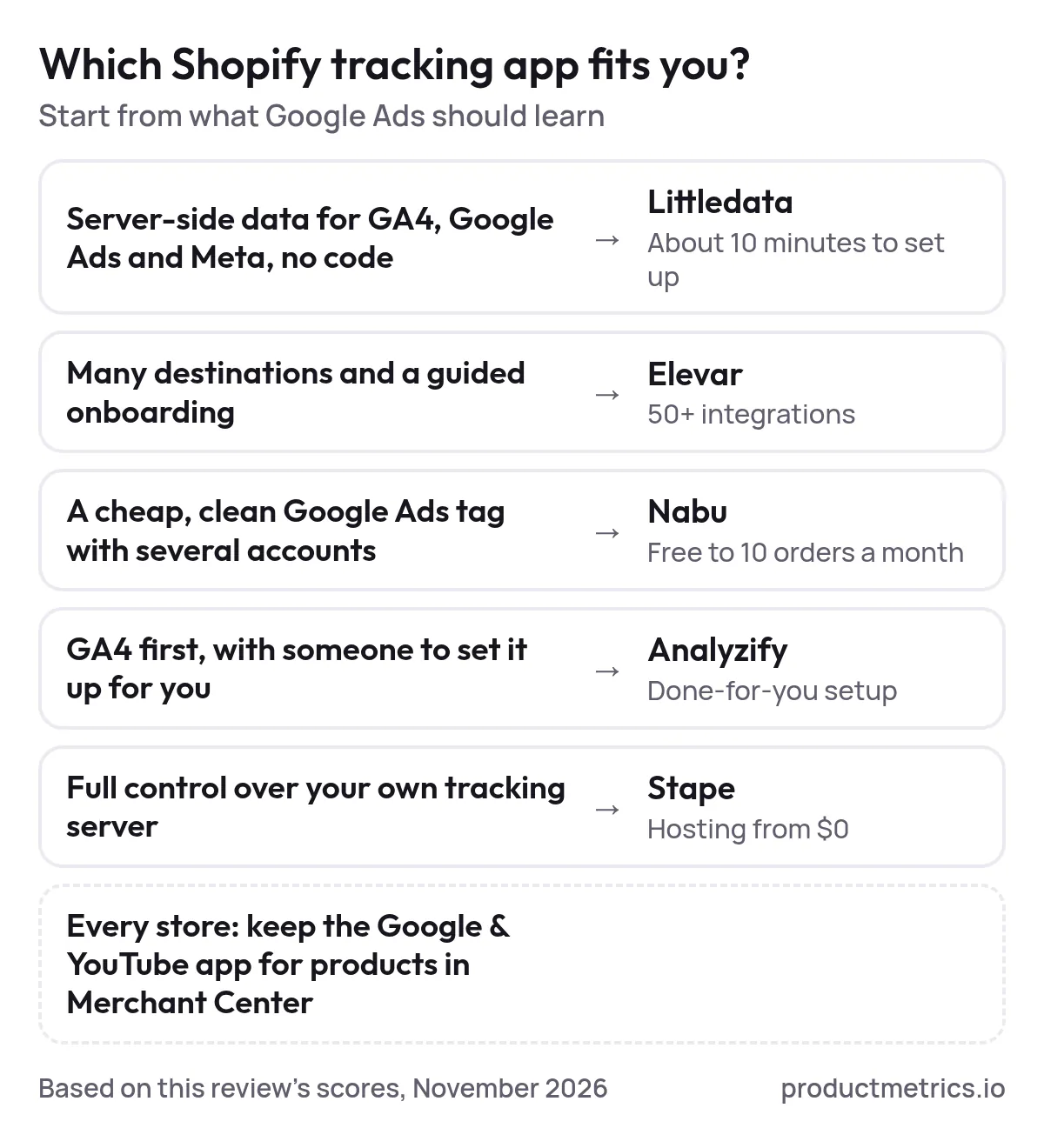
The right app depends on what Google Ads should learn from each order:
- If a marketer must set up server-side tracking alone, in minutes → choose Littledata.
- When the same purchases go to many ad and email platforms → choose Elevar.
- If you need a cheap, clean tag across several Google Ads accounts → choose Nabu.
- When GA4 matters most and someone else should set it up → choose Analyzify.
- If your team uses Google Tag Manager and wants its own tracking server → choose Stape.
Whatever you pick, make one purchase conversion primary so orders aren’t counted twice; our Google Ads conversion tracking guide covers that check. For tools beyond Shopify, see the server-side tracking tools comparison.
Written by
Berend Vrakking, Founder of Product Metrics
1M+ products analysed · Nominated at the Dutch Search Awards for Best Measurement Campaign (2023) and Best Use of Data (2024)
Keep reading.
What Does Google Ads Conversion Tracking Cost? Setup, Tools, Hosting and Upkeep
What does Google Ads conversion tracking cost? The five parts of the bill, priced from Google's own figures and our price list, plus what to ask.
How Much Does Server-Side Tracking Cost for Google Ads? Server-Side GTM vs a Hosted App
How much does server-side tracking cost for Google Ads? Hosting, setup and upkeep for server-side GTM against a hosted app, with Google's figures.
Best Google Ads Conversion Tracking Apps for Lightspeed eCom
Best Google Ads conversion tracking apps for Lightspeed eCom (C-Series), scored on five criteria: ROASaurus, ProfitMetrics, AdPage and more.
Frequently asked questions.
Why is my Shopify Google Ads conversion tracking inaccurate?
How do I set up Shopify enhanced conversions without GTM?
How do I track profit in Google Ads for a Shopify store?
See which of your products to push, fix or pause. Start with your own products, or a 30-second estimate.
See what a blocker stops with the ad blocker tracking test. Then see how your products perform once every conversion is counted.
Questions, or want to spar about your products? Book a demo: a video call with Berend, then a demo account.